This is Part 5 of the Enterprise Intelligence Platform Playbook series. Part 1 made the case for the platform. Part 2 proposed an 8-layer reference architecture. Part 3 introduced the three new engineering disciplines. Part 4 covered operating intelligence reliably. Part 5 answers the final question: how do you get there?
Most enterprises are asking how to adopt AI. That is the wrong question. The better question is: how does an organization evolve into an intelligence-native enterprise?
Platform Engineering did not appear overnight. Neither will Enterprise Intelligence Engineering. Transformation requires deliberate architectural, organizational, and cultural change spread across years.
This article proposes a five-stage maturity model and a two-year actionable roadmap. The goal is not to predict the future. It is to give engineering leaders a framework for making decisions today that do not close off better options tomorrow.
The Enterprise Intelligence Maturity Model
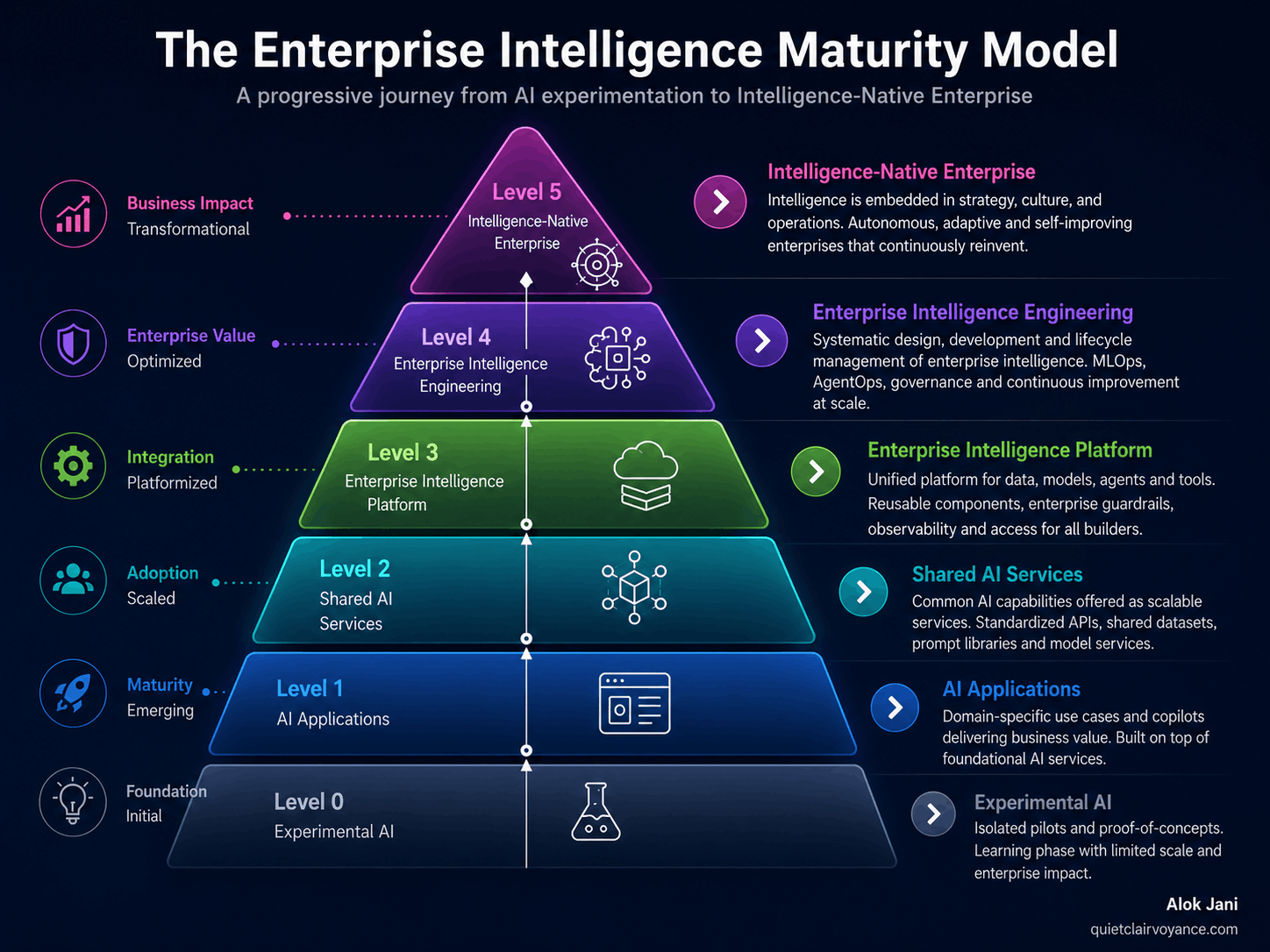
| Level | Name | Description | Warning Sign |
|---|---|---|---|
| 0 | Experimental AI | Isolated chatbots and individual productivity tools. Prompt engineering by early adopters. Little governance, no shared platform, no standard approach. | Every team has its own OpenAI API key and its own vector database. |
| 1 | AI Applications | Teams embed AI into products. Copilots, RAG pipelines, workflow automation. Multiple models, multiple approaches, basic governance. | Three teams independently built the same document Q&A feature with different architectures and different model providers. |
| 2 | Shared AI Services | Organization recognizes duplication and begins consolidating. Shared model gateway, vector platform, prompt registry. Basic evaluation pipelines. | Teams are using the shared model gateway but still building their own context pipelines, decision logic, and governance. |
| 3 | Enterprise Intelligence Platform | Dedicated platform organization. Shared memory, context engineering, decision fabric, action fabric, governance runtime, agent runtime, observability, evaluation infrastructure. | The platform exists but not all teams use it. Shadow AI projects bypass the platform. |
| 4 | Enterprise Intelligence Engineering | Organization has transformed how it builds AI. Dedicated teams own context, decisions, actions, governance, reliability. Three new disciplines established. | The organization is operating well at this level. The real risk is complacency. |
| 5 | Intelligence-Native Enterprise | Intelligence embedded into every business capability. Every decision improves future decisions. Institutional cognition. Continuous feedback loops. | There is no warning sign. If you reach Level 5, you are defining the industry standard. |
A Two-Year Enterprise Transformation Roadmap
The journey from Level 1 to Level 3 is the practical horizon for most enterprises today. Level 4 and 5 are the north star. Here is a phased approach.
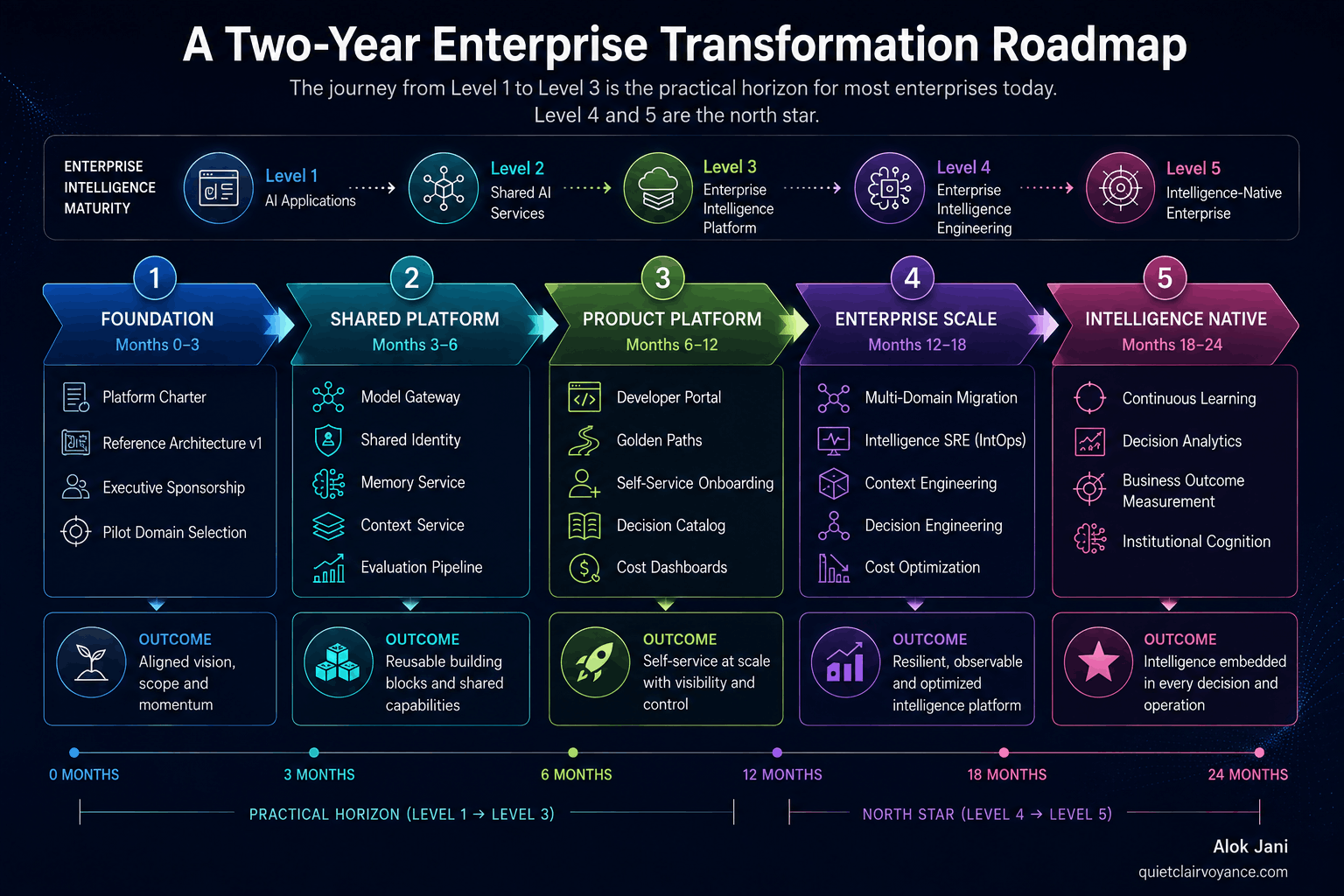
Phase 1 (Months 0–3): Establish Foundations
Objective: Create the organizational conditions for platform success.
Actions:
Form an AI Platform leadership group. This is not a steering committee that meets quarterly. It is a working group of engineering leaders, platform engineers, and product managers that meets weekly and makes decisions.
Inventory existing AI initiatives. Every team building something with AI. Every model provider in use. Every vector database running. Every governance gap. Every duplicated effort. The inventory reveals the fragmentation that the platform will solve.
Define platform principles. What will the platform standardize? What will it leave flexible? What is in scope for the central team and what belongs to application teams? Write these down and socialize them.
Select the first platform investments. Based on the inventory, identify the two or three capabilities that deliver the most leverage when shared. In most organizations, the model gateway and identity are the right starting points.
Identify pilot domains. Two or three high-value, contained use cases where the platform can demonstrate value in Phase 2.
Deliverables: AI Platform Charter, Reference Architecture v1 (from Part 2), security and governance baseline, executive sponsorship, pilot domain selection.
Phase 2 (Months 3–6): Build Shared Platform Services
Objective: Deliver tangible platform capabilities that eliminate duplication.
Actions:
Build the model gateway. Every model call routes through a single entry point with authentication, rate limiting, cost tracking, and audit logging. Model providers become interchangeable behind the gateway.
Deploy shared identity and secrets. Every agent gets a distinct identity with least-privilege access. Secrets management is centralized. No more API keys in environment variables.
Build enterprise memory and context services. Start with the retrieval infrastructure - vector database, embedding pipeline, cache layer. Add context assembly in the next iteration.
Create the initial action catalog. Identify the first three to five business capabilities that should be actions instead of tools. Define them with preconditions, execution plans, rollback procedures, and success criteria.
Establish evaluation pipelines. Start with offline evaluation against golden datasets. Add shadow evaluation for pilot domains.
Deliverables: Model Gateway, Context Service, Memory Service, Evaluation Pipeline, Developer Portal for platform services.
Phase 3 (Months 6–12): Productize the Platform
Objective: Make the platform self-service so teams adopt it by choice.
Actions:
Launch self-service onboarding. A developer portal where teams can register agents, declare scope, configure evaluation, and deploy through the platform’s pipeline. No tickets. No manual reviews for standard cases.
Publish golden paths. Documented, supported patterns for the most common agent types: Q&A agents, summarization agents, workflow automation agents, copilots. Each golden path includes the platform services it uses, the evaluation suite it requires, and the deployment model it follows.
Standardize observability and governance. Every agent deployed through the platform inherits tracing, cost tracking, policy enforcement, and audit logging. No opt-out for production deployments.
Build reusable decision libraries. Common decision patterns - approval workflows, risk assessments, policy evaluations - become platform services that teams compose rather than rebuild.
Implement cost dashboards. Every team can see their AI spend per agent, per model provider, per use case. Cost data drives optimization conversations.
Deliverables: Internal AI Developer Platform, Action Registry, Decision Catalog, Platform SLIs and SLOs, Cost Dashboards.
Phase 4 (Months 12–18): Scale Across the Enterprise
Objective: Migrate product teams to platform services and expand coverage.
Actions:
Migrate existing AI applications. Work with each team to move their model calls to the gateway, their context to the context service, their agents to the runtime. This reduces fragmentation and surface area for incidents.
Reduce duplicate implementations. Every RAG pipeline, every prompt template, every evaluation script that teams built independently becomes a platform service or a deprecated pattern.
Introduce Intelligence SRE. Establish the IntOps discipline from Part 4. Define SLIs and SLOs for decision accuracy, context freshness, policy compliance, and cost per decision. Build runbooks for the intelligence failure modes.
Expand business capability coverage. Double the action catalog. Add context engineering as a dedicated capability (Part 3). Begin decision engineering for the highest-value decision types.
Implement cost optimization. Use cost data to recommend model downgrades for low-complexity tasks, cache optimization, and prompt efficiency improvements.
Deliverables: Multi-domain adoption, Executive KPI Dashboard, Organization-wide standards, Intelligence SRE practice, Reliability reviews.
Phase 5 (Months 18–24): Institutionalize Intelligence
Objective: Close the feedback loops and make learning a production capability.
Actions:
Embed intelligence into core business processes. Not isolated AI features but intelligence-native workflows where decisions, actions, and learning are part of how the business operates.
Close the learning loops. Every decision outcome flows back into context, decisions, and actions. Successful decisions reinforce retrieval strategies. Failed decisions update policy models. Human corrections improve evaluation criteria.
Optimize cost and quality at scale. Use the cost and quality data accumulated over 18 months to make systematic optimization decisions. Which model for which use case? Which context strategies produce the best outcomes? Which policies create friction without reducing risk?
Measure business outcomes, not model metrics. The executive dashboard tracks decision quality, business outcome improvement, platform adoption rates, time-to-onboard for new AI products, cost per decision, and learning velocity. These are not ML metrics. They are operational metrics.
Deliverables: Continuous learning pipelines, Enterprise decision analytics, Outcome-based governance, AI portfolio reviews, Institutional cognition.
Evaluating Agentic Systems
Agentic systems involve multi-step reasoning, tool calling, branching logic, and intermediate state transitions. Evaluating only the final output is insufficient. A correct final answer can mask a broken reasoning path, wrong tool parameters, or an inefficient trajectory.
Trajectory evaluation. Evaluate the path, not just the destination. Did the agent use the right tools in the right order? Did it take the most efficient route? Did it make unnecessary API calls? A correct answer reached through five unnecessary steps is an inefficient agent.
Tool calling accuracy. Evaluate whether the agent called the right tool with the right parameters. A refund agent that calls the inventory API instead of the payment API is wrong, even if the final output looks correct. Tool calling accuracy is a Gate 1 check.
Intermediate state validation. Evaluate state transitions at each step. Did the agent maintain correct context? Did it handle errors gracefully? Did it branch correctly based on conditions? State validation catches logic errors that final output evaluation misses.
Multi-agent orchestration. When multiple agents collaborate, evaluate the handoffs. Did Agent A pass correct context to Agent B? Did the orchestrator make the right routing decisions? Did the system handle agent failures gracefully? Orchestration evaluation requires tracing across agent boundaries.
This is the challenge. Eval-Driven Development is the solution.
Eval-Driven Development: Standardizing Intelligence Quality
The Intelligence Pipeline standardizes how decisions flow. Eval-Driven Development standardizes how evaluation flows. Without EDD, every team evaluates differently. Some measure accuracy. Others measure latency. Few measure whether decisions actually improve business outcomes. The result is fragmented quality that no one can compare, benchmark, or improve systematically.
EDD builds the infrastructure and habits to discover, encode, and continuously test for failure modes as they appear. It forces stakeholders to externalize what “good” means. When you cannot define good, you cannot measure it. When you cannot measure it, you cannot improve it. When you cannot improve it, you are gambling, not engineering.
The Three-Gate Evaluation Stack
Every evaluation you run will use one or a combination of three methods. The stack progresses from fast, cheap checks to slow, expensive validation. Each gate catches different failure modes.
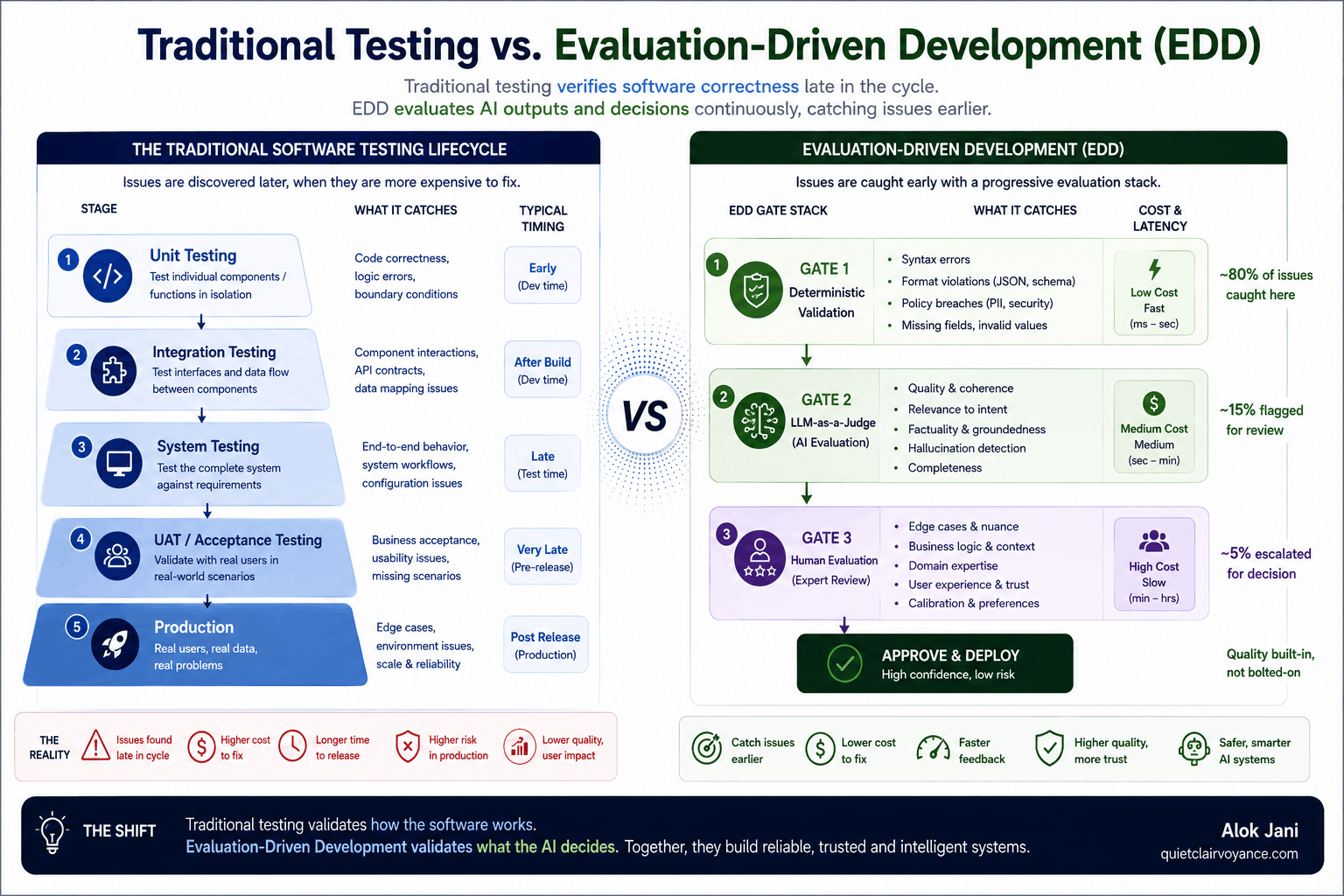
Gate 1: Deterministic Validation. Code-based checks that don’t require an LLM. Syntax errors, format violations, policy breaches, missing required fields, output length constraints. This layer runs on every evaluation and catches 80% of failures before they reach expensive evaluation layers. Think of it as the linting stage for intelligence.
Gate 2: LLM-as-a-Judge. Nuanced evaluation that catches quality issues deterministic checks miss. Coherence scoring, relevance ranking, factuality verification, tone assessment. This layer uses a stronger model to evaluate weaker model outputs, or uses the same model with different prompts to check consistency. Medium cost, medium latency. Catches the quality issues that matter for user experience.
Gate 3: Human evaluation. High-resource validation that calibrates the entire stack. Subject matter experts review edge cases, validate business logic, and label golden datasets. This layer is not scalable for every evaluation, but it is essential for calibration. Start with 20-100 rows labeled by subject-matter experts. Use these labels to tune Gate 2 judges and validate Gate 1 rules.
EDD as a Platform Service
Evaluation should not be something every team builds from scratch. Like the model gateway and context service, evaluation is a shared platform capability. The platform provides:
Shared evaluation infrastructure. A unified evaluation runtime that runs all three layers. Teams configure evaluations, the platform executes them. No custom scripts. No duplicated tooling.
Golden dataset management. Evaluation datasets are organizational assets, not team artifacts. Version them. Curate them. Share them across teams. A refund evaluation dataset created by the retail team should be reusable by any team building refund-related agents.
Evaluation CI/CD integration. Evaluation results gate deployments. A model update that degrades evaluation scores does not reach production. A prompt change that improves one metric but regresses another triggers investigation. Evaluation is not a report. It is a deployment gate.
Open-source tooling. The evaluation stack does not require proprietary platforms. DeepEval provides programmatic checks and LLM-as-a-Judge capabilities out of the box. RAGAS evaluates retrieval-augmented generation pipelines. LangSmith traces agent trajectories for evaluation. These tools integrate with existing CI/CD pipelines and cost nothing per evaluation run.
Common Anti-Patterns
The roadmap is straightforward. The execution is not. Here are the anti-patterns that derail enterprise intelligence transformations:
Every team building its own AI stack. The most common and most destructive anti-pattern. It creates fragmentation that compounds every quarter. The platform exists to prevent this, but it only works if teams adopt it.
Treating AI as a feature instead of a platform. The product team adds a copilot. The engineering team wires up an LLM call. No one asks what shared services the copilot needs or what other teams could benefit from the same infrastructure. The feature ships. The platform does not evolve.
Optimizing for model performance while ignoring governance. The team benchmarks models on accuracy but does not measure policy compliance, cost, or human override rates. The model performs well on the benchmark and poorly in production because it violates business rules or generates unacceptable recommendations.
Measuring token usage instead of business outcomes. Tokens are an input metric. They tell you how much you are spending, not what you are getting. Switch to cost per decision and business outcome improvement as soon as possible.
Deploying autonomous agents without human accountability. The agent runs without supervision. A decision causes harm. No one knows who is responsible. Define accountability chains before deployment, not after incident.
Building proprietary integrations that cannot be reused. The team builds a custom connector to a data source, a custom vector store, a custom evaluation script. None of it is designed for reuse. The next team builds their own. The cycle repeats.
Building custom evaluation scripts instead of using platform service. Every team builds its own evaluation pipeline. Different metrics, different datasets, different thresholds. No one can compare quality across teams. The platform provides shared evaluation infrastructure. Use it.
Evaluating only final output, not intermediate steps. The team measures whether the agent produced the right answer but not whether it used the right tools, followed the right path, or maintained correct context. A correct final answer can mask a broken reasoning path. Evaluate the trajectory, not just the destination.
Each anti-pattern increases long-term complexity. Platform thinking reduces it.
The Decade Ahead
The 1990s produced ERP systems. The 2000s produced cloud computing. The 2010s produced Platform Engineering. The 2020s are producing Enterprise Intelligence Platforms.
We once built systems that stored data. Then we built platforms that delivered software. The next generation of enterprises will build platforms that continuously improve decisions. That is what Enterprise Intelligence Platforms make possible. One pipeline. Shared intelligence. Continuous learning. Every decision better than the last.
The organizations that lead this decade will not be remembered because they deployed the most sophisticated language models. They will be remembered because they created the architectural, operational, and organizational foundations that allowed intelligence to become a shared enterprise capability.
History rarely rewards the teams that adopt technology first. It rewards the organizations that build the platform others depend upon. The organizations that build Enterprise Intelligence Platforms first will define the next decade.