This is Part 4 of the Enterprise Intelligence Platform Playbook series. Part 1 made the case for the platform. Part 2 proposed the reference architecture. Part 3 introduced the three new engineering disciplines. Part 4 answers the question: how do you standardize enterprise intelligence at scale?
Every major technology shift eventually standardized around a common pipeline.
Manufacturing standardized assembly lines. Data engineering standardized ETL pipelines. Cloud standardized CI/CD pipelines. Platform Engineering standardized software delivery.
Enterprise Intelligence is following the same pattern. But today, most organizations are doing it wrong.
Each team builds its own ingestion process. Its own retrieval strategy. Its own prompts. Its own orchestration. Its own evaluation framework. Its own governance model. Its own monitoring dashboards. Its own operational playbooks.
The result is predictable. More agents. More complexity. Less consistency.
Here is the uncomfortable truth: the future will not look like hundreds of unique AI systems. The future looks like one Enterprise Intelligence Pipeline that powers every decision agent across the enterprise.
One Pipeline Powers Every Decision Agent
Think about the decisions your organization makes every day.
Approving a mortgage. Diagnosing a network outage. Routing customer support tickets. Provisioning cloud infrastructure. Optimizing inventory. Detecting fraud. Scheduling field engineers.
Here is the thing: every single one of those decisions follows the same fundamental lifecycle. The technologies may change. The models will evolve. But the pipeline remains remarkably stable.
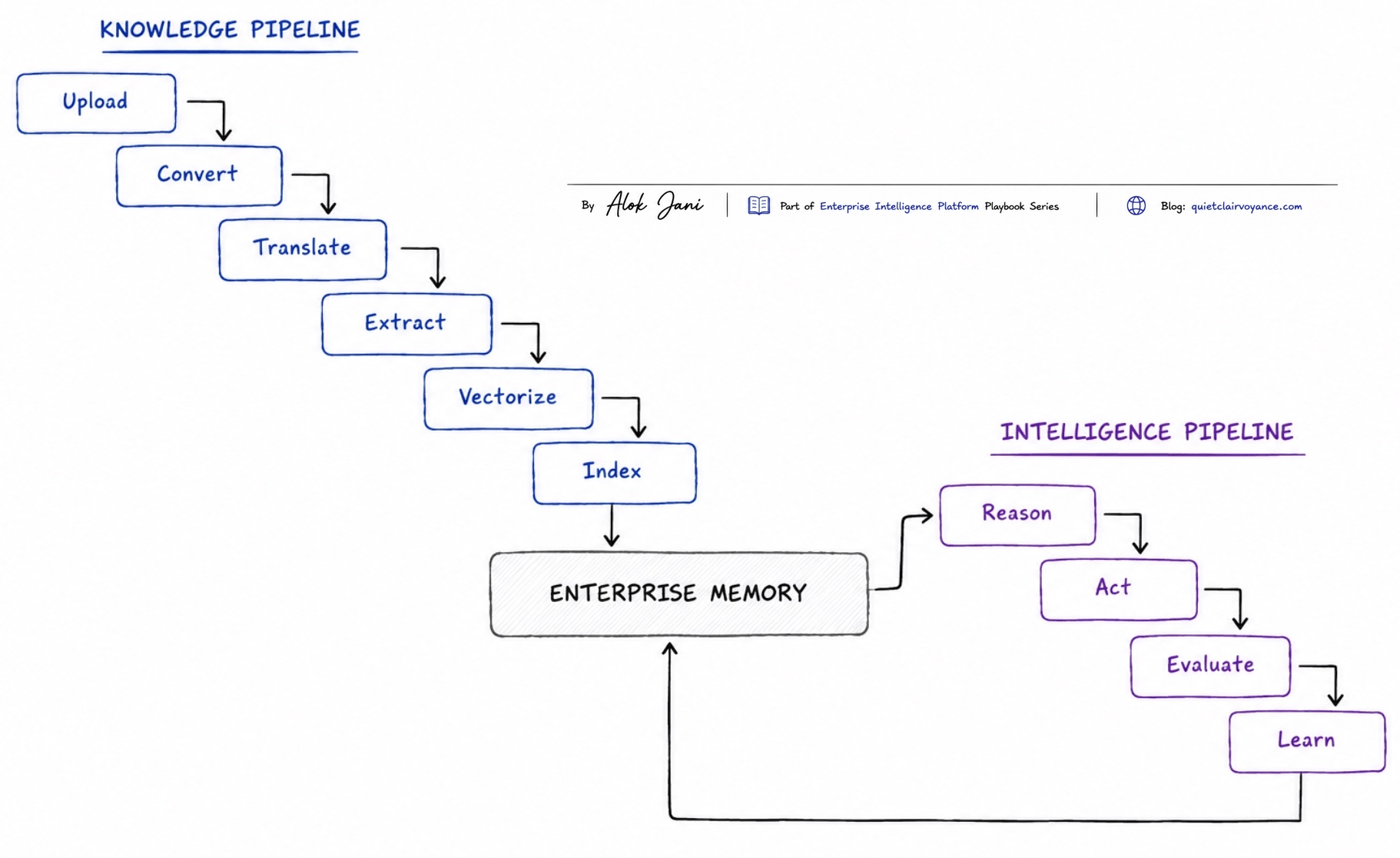
This is the Enterprise Intelligence Pipeline. One pipeline. Two halves. Ten stages.
The Knowledge Pipeline transforms raw information into trusted organizational knowledge. The Intelligence Pipeline transforms that knowledge into business outcomes. Enterprise Memory sits in the middle, bridging the two.
Let us walk through each half.
Half 1: The Knowledge Pipeline
Before an enterprise can make intelligent decisions, it must first transform raw information into trusted organizational knowledge. That is what the Knowledge Pipeline does.
Its job is not to answer questions. Its job is to prepare enterprise knowledge for reasoning. Think of it as the enterprise equivalent of “garbage in, garbage out.” If your knowledge pipeline is broken, your decisions will be too.
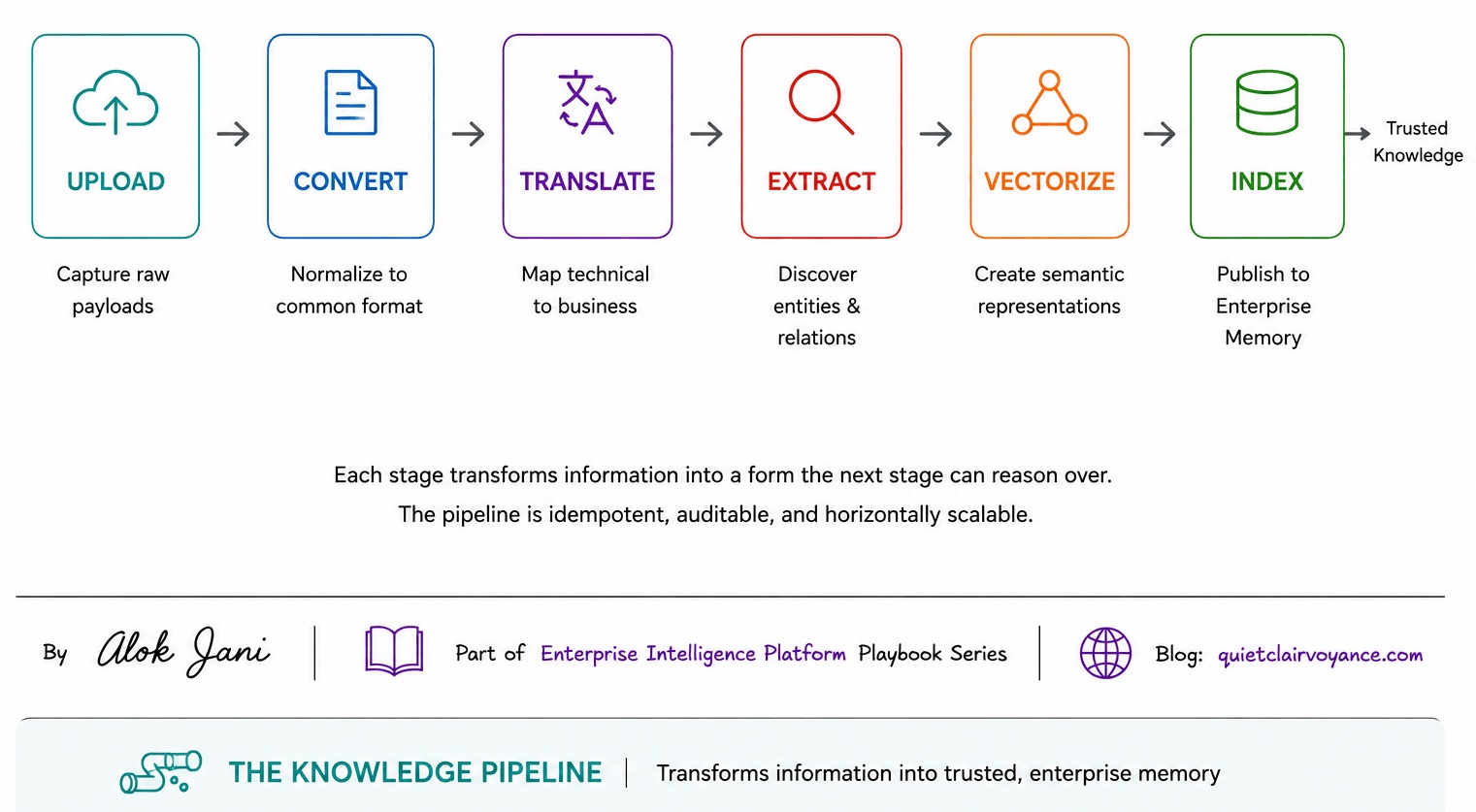
Stage 1 - Upload
Everything begins with information entering the enterprise.
Sometimes this is a PDF. Sometimes an email. Sometimes an API request. Sometimes a Kafka event. Sometimes a database update. Sometimes a sensor reading. Sometimes a customer places an order. Sometimes an engineer opens an incident.
Every event contributes new enterprise knowledge. The source does not matter. The knowledge does.
| Industry | Upload Sources |
|---|---|
| Retail | Order systems, returns portal, invoice and payment data, product catalog, policy documents, customer data, log data |
| Pharma | EHR systems, lab reports, medical images, clinical notes, research papers, guidelines |
| Banking | Core banking systems, payment rails, KYC documents, transaction logs, compliance filings, customer communications |
| Travel | Booking systems, PNR feeds, loyalty programs, airport ops, weather feeds, regulatory advisories, customer support tickets |
| Defence | Sensor feeds, maintenance logs, mission systems, supply chain, personnel records, threat intelligence, operational orders |
Stage 2 - Convert
Information rarely arrives in a useful format. PDFs require OCR. Images require recognition. Audio requires transcription. Structured systems expose different schemas. Legacy applications use proprietary formats.
The Convert stage normalizes every source into a common machine-readable representation. The rest of the platform no longer needs to understand where information came from. That is the whole point.
| Source Format | Conversion Method | Output Format |
|---|---|---|
| OCR + text extraction | Structured text | |
| Image | Vision model + OCR | Text + metadata |
| Audio | Speech-to-text | Transcript |
| CSV/Excel | Schema mapping | Normalized JSON |
| API response | Schema normalization | Normalized JSON |
| Database CDC | Debezium | Normalized events |
| Parser + NLP | Structured text | |
| Sensor data | Protocol decoding | Normalized events |
Stage 3 - Translate
Here is where things get interesting. Machines process syntax. Businesses operate on meaning.
Translation transforms technical information into business understanding. A document becomes a policy. A support ticket becomes an incident. A purchase order becomes a business transaction. A log entry becomes an operational event.
Translation aligns enterprise knowledge with the language of the business. Without it, your AI is translating technical jargon instead of making decisions.
| Technical Input | Business Translation | Domain |
|---|---|---|
| API response 200 OK | Transaction successful | Finance |
| HTTP 500 error | Service failure | Operations |
| CPU > 90% | Capacity threshold exceeded | Infrastructure |
| Ticket status: open | Unresolved incident | Support |
| Invoice pending | Payment awaiting processing | Finance |
| Sensor reading > threshold | Equipment anomaly | Manufacturing |
| Customer complaint | Service quality issue | Customer Success |
Stage 4 - Extract
Once information has meaning, valuable knowledge can be discovered.
The platform identifies business entities, relationships, metadata, policies, constraints, classifications, ownership, timestamps, and compliance attributes. Raw information becomes structured enterprise knowledge.
Here is what this looks like in practice:
Retail. A customer emails about a defective product. The Extract stage pulls out: customer ID, order number, product SKU, defect category, return window status, refund eligibility, customer tier, and previous complaint history. That email becomes a structured knowledge object that the reasoning engine can act on.
Pharma. A clinical trial site submits a adverse event report as a PDF. The Extract stage pulls out: patient ID, drug dosage, event severity, onset date, concomitant medications, and regulatory reporting thresholds. That PDF becomes a structured object that triggers FDA reporting workflows if severity exceeds Phase 2 limits.
| Industry | Raw Input | Entities Extracted | Downstream Decision |
|---|---|---|---|
| Retail | Customer email | Customer, Order, SKU, Defect, Tier | Approve refund, escalate to retention |
| Pharma | Adverse event PDF | Patient, Drug, Severity, Dosage, Reporter | FDA report, trial pause, dosage review |
Stage 5 - Vectorize
This is where traditional information systems begin to diverge from Enterprise Intelligence.
Instead of storing information solely as documents or database rows, the platform creates semantic representations that AI systems can reason over. Vectorization captures similarity, intent, relationships, and meaning. Enterprise knowledge becomes discoverable through concepts rather than keywords.
Vectorization does not replace structured data. It complements it. Relational databases answer exact questions. Vectors answer semantic questions. Together they enable intelligent retrieval.
| Question Type | Best Storage | Example |
|---|---|---|
| Exact match | PostgreSQL | “Show me order #12345” |
| Fuzzy match | PostgreSQL + trigram | “Find similar orders” |
| Semantic search | Vector DB | “What’s our policy on refunds?” |
| Relationship traversal | Graph DB | “What systems does this service depend on?” |
| Temporal query | PostgreSQL + pg_temporal | “What was the status last week?” |
Here is what vectorization looks like in practice:
Retail. A customer returns a defective laptop. The Vectorize stage creates embeddings for: the return reason (“screen flickers”), the product (“Dell XPS 15”), the customer history (“3 returns in 6 months”), and the policy (“defective electronics return window”). When a similar case arrives, the reasoning engine finds it through semantic similarity, not keyword matching. “Screen flickers” matches “display intermittent failure” even though the words are different.
Pharma. A clinical trial reports nausea as an adverse event. The Vectorize stage creates embeddings for: the symptom (“nausea”), the drug (“Metformin 500mg”), the severity (“Grade 2”), and the patient population (“Type 2 Diabetes, age 45-60”). The reasoning engine finds similar adverse events across trials, even when the terminology varies. “Nausea” matches “gastrointestinal distress” and “stomach upset.”
| Industry | What Gets Vectorized | Why It Matters |
|---|---|---|
| Retail | Return reasons, product descriptions, customer history, policy text | Find similar returns even when wording differs |
| Pharma | Symptoms, drug names, severity grades, patient populations | Match adverse events across trials with different terminology |
Stage 6 - Index
Knowledge is now ready to become part of Enterprise Memory. The Index stage publishes information into multiple representations simultaneously: relational databases, graph databases, vector indexes, document stores, caches, and temporal history.
Each store serves a different query pattern. The reasoning engine decides which store to query based on the decision context.
Here is what most people miss: not all knowledge belongs in the same place. The Index stage makes intelligent routing decisions about where each piece of knowledge lives, based on how it will be consumed.
Retail. A customer refund request gets indexed in three places: PostgreSQL for the transaction record, Qdrant for semantic search (“customers who returned defective electronics”), and Neo4j for the relationship graph (customer -> order -> product -> supplier). The reasoning engine can query any of these depending on the decision context.
Pharma. An adverse event report gets indexed in PostgreSQL for the regulatory record, Qdrant for semantic search across similar adverse events, and a compliance document store for FDA audit trails. The reasoning engine queries the compliance store first to check reporting deadlines.
| Knowledge Type | PostgreSQL | Qdrant (Vector) | Neo4j (Graph) | Document Store |
|---|---|---|---|---|
| Retail transaction | Order record | “similar refund patterns” | Customer-order-supplier | Return policy PDF |
| Pharma adverse event | Event record | “similar adverse events” | Patient-drug-trial | FDA compliance docs |
Enterprise Memory
Enterprise Memory is the bridge between knowledge and intelligence. It represents everything the organization knows at this moment. Policies. Customers. Products. Assets. Services. Employees. Events. Operational history. Business relationships. Historical decisions.
Unlike traditional databases, Enterprise Memory continuously evolves as the enterprise learns. Every future decision depends on the quality of this memory. Poor memory creates poor decisions. Rich memory creates intelligent organizations.
The memory is not a single store. It is a hierarchy of specialized stores, each optimized for a different access pattern. Real-time sessions need sub-millisecond latency. Historical analysis needs batch throughput. Relationship queries need graph traversal. The hierarchy ensures each use case gets the right storage without compromising the others.
| Memory Type | Purpose | Technology | Update Frequency |
|---|---|---|---|
| Working memory | Active sessions | Redis | Real-time |
| Conversational memory | Multi-turn context | Redis + PostgreSQL | Per conversation |
| Task memory | Workflow state | PostgreSQL | Per workflow |
| Operational memory | System state | PostgreSQL + Qdrant | Real-time |
| Historical memory | Patterns and trends | MinIO + Trino | Daily |
| Organizational memory | Institutional knowledge | Neo4j + Qdrant | Weekly |
Half 2: The Intelligence Pipeline
Knowledge alone has no business value. Value is created only when knowledge becomes action. The Intelligence Pipeline transforms Enterprise Memory into business outcomes.
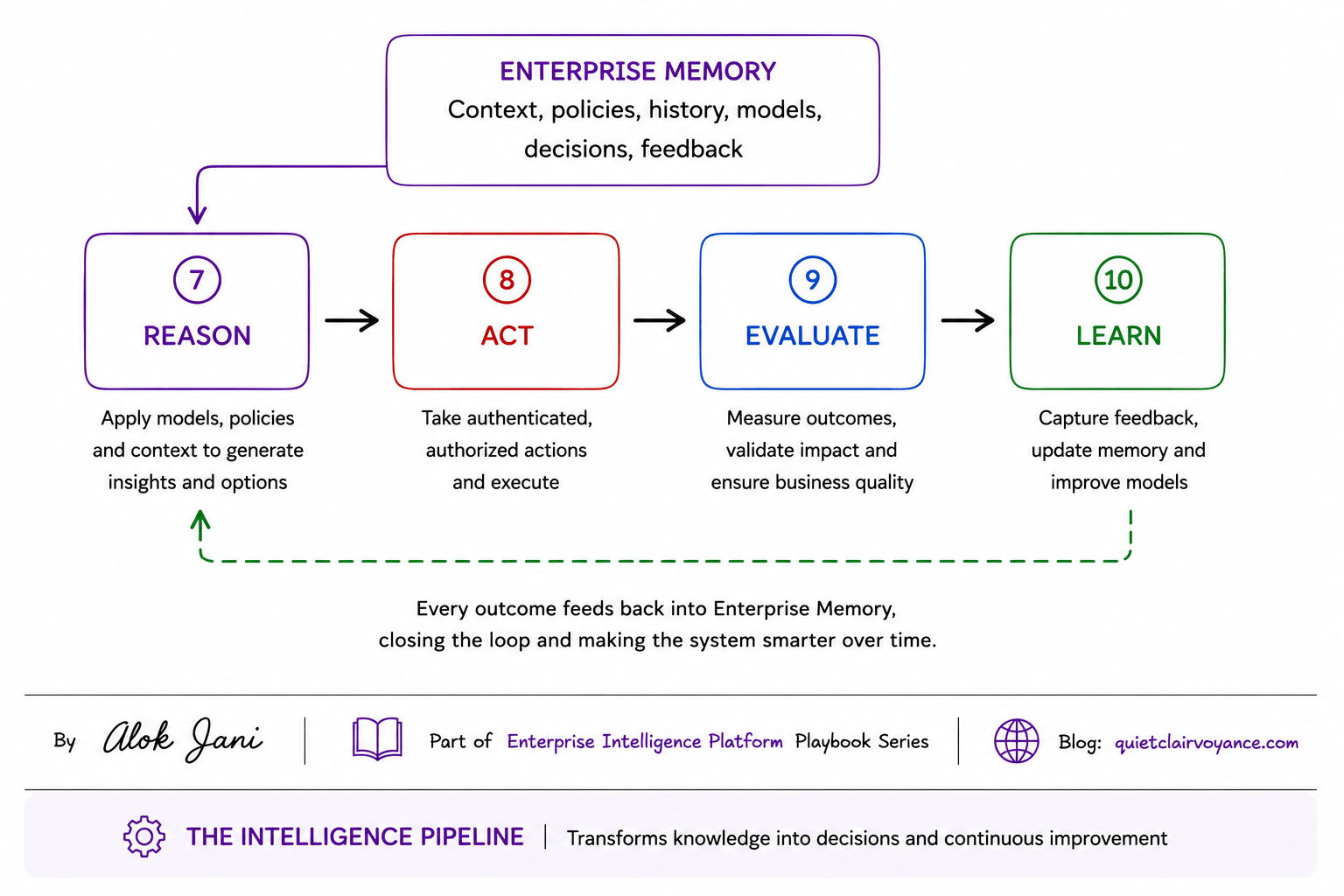
Stage 7 - Reason
Reasoning is far more than prompting an LLM. It is the execution of enterprise decision logic.
Reasoning combines Enterprise Memory, decision models, business policies, optimization algorithms, AI models, and human constraints to produce an explainable business decision. This stage is owned by Decision Engineering, introduced in Part 3.
The mistake most organizations make is thinking prompting is reasoning. Prompting is how you talk to a model. Reasoning is how the enterprise makes decisions. They are not the same thing.
| Reasoning Component | What It Does | Example |
|---|---|---|
| Enterprise Memory | Provides context (customer, order, history) | “This customer returned 3 items in 30 days” |
| Business Rules | Applies deterministic logic | “Return window is 30 days, this is day 32” |
| Policies | Enforces compliance | “Gold tier customers get extended window” |
| Optimization | Solves tradeoffs | “Refund amount vs. retention value” |
| AI Model | Handles ambiguity | “Defective product claim with no receipt” |
| Human Constraint | Escalates when uncertain | “Confidence below threshold, escalate to agent” |
Stage 8 - Act
A decision creates value only when something changes. That is what Action Engineering owns.
Actions may include: approving a transaction, provisioning infrastructure, dispatching a technician, notifying a customer, escalating to a human, triggering a workflow, or updating enterprise systems. Every action is authenticated, authorized, observable, reversible, and auditable.
Here is what this looks like in practice:
Retail. The reasoning engine approves a refund. The Act stage orchestrates: payment gateway reversal, inventory restock notification, customer email, CRM update, and audit log. One decision. Five systems updated. The customer sees the refund before the agent finishes the conversation.
Pharma. The reasoning engine determines an adverse event exceeds FDA reporting threshold. The Act stage orchestrates: FDA MedWatch submission, trial sponsor notification, site investigator alert, data safety monitoring board escalation, and patient safety assessment trigger. One decision. Five compliance workflows launched within the regulatory window.
| Industry | Decision | Actions Orchestrated | Outcome |
|---|---|---|---|
| Retail | Approve refund | Payment reversal, inventory update, customer email, CRM sync, audit log | Customer satisfied, inventory restored |
| Pharma | Report adverse event | FDA submission, sponsor alert, investigator notify, DSMB escalation, patient safety review | Compliance met, patient protected |
Stage 9 - Evaluate
Traditional software measures availability. Enterprise Intelligence measures decision quality. Every decision should be evaluated across multiple dimensions.
Technical quality: latency, reliability, availability.
Intelligence quality: context quality, reasoning quality, confidence, explainability.
Business quality: customer outcome, operational impact, policy compliance, human overrides.
Evaluation determines whether intelligence is actually improving the business. Without it, you are flying blind.
| Evaluation Dimension | Metrics | Target | How to Measure |
|---|---|---|---|
| Technical | Latency, throughput, error rate | p95 < 500ms, > 99.9% success | Distributed tracing |
| Intelligence | Context precision, reasoning coherence | > 90% precision, > 95% coherence | Automated evaluation |
| Business | Outcome achievement, ROI | > 85% outcome rate | Business metrics |
| Compliance | Policy adherence, audit coverage | 100% compliance | Policy checking |
Stage 10 - Learn
This is where the magic happens. The final stage closes the loop.
Every outcome becomes new enterprise knowledge. Successful decisions strengthen confidence. Failures expose policy gaps. Overrides improve reasoning. Feedback improves retrieval.
Learning continuously updates Enterprise Memory, decision models, policies, evaluation datasets, and operational metrics. The platform becomes more intelligent with every decision.
This is what separates the leaders from the laggards: organizations that learn faster will outperform organizations that simply deploy newer models. Learning is not optional. It is the entire point.
Enterprise Intelligence Operations
Operating this pipeline reliably is the responsibility of Enterprise Intelligence Operations.
Traditional Site Reliability Engineering asks: “Is the platform available?” Enterprise Intelligence Operations asks: “Can the enterprise trust every decision flowing through the pipeline?”
That is a very different question. SRE keeps systems up. Enterprise Intelligence Operations keeps decisions trustworthy.
Rather than monitoring infrastructure alone, Enterprise Intelligence Operations continuously observes the health of every stage: Is new knowledge arriving correctly? Is enterprise memory current and trustworthy? Are decisions consistent? Are actions executing successfully? Are business outcomes improving? Is the system learning from every interaction?
Enterprise Intelligence Operations does not operate models. It operates the flow of enterprise intelligence. That is a critical distinction.
Knowledge Pipeline SLOs
| SLO | Definition | Example |
|---|---|---|
| Upload Rate | Number of raw events ingested into the pipeline per minute from all enterprise sources | A retail platform ingests 1.2k events/min from order systems, returns portals, and customer logs |
| Conversion Accuracy | Percentage of documents successfully converted from raw format to structured text without errors | 99.8% of PDF return requests are correctly parsed into structured text with order ID, SKU, and reason |
| Translation Accuracy | Percentage of technical signals correctly mapped to business meaning and domain context | A “500 error” is correctly translated to “Service Failure” in Operations, not “Transaction Error” in Finance |
| Extraction Accuracy | Percentage of business entities, relationships, and metadata correctly identified and extracted | A customer email yields: Customer ID, Order #, SKU, Defect Category, Return Window Status, Refund Eligibility |
| Vectorization Accuracy | Percentage of embeddings generated without errors and stored in the correct vector collections | A refund request embedding is stored in “customer-returns” collection, not “product-catalog” |
| Indexing Accuracy | Percentage of knowledge artifacts stored in the correct downstream stores based on query patterns | A return request is indexed in PostgreSQL (transaction), Qdrant (semantic search), and Neo4j (relationships) |
Intelligence Pipeline SLOs
| SLO | Definition | Example |
|---|---|---|
| Decision Rate | Number of business decisions processed end-to-end per minute through the full pipeline | 847 refund decisions processed per minute across all retail channels |
| Decision Accuracy | Percentage of decisions that are correct as validated by sampling and human review | 99.2% of refund approvals are valid - only 0.8% are overturned on appeal |
| Decision Latency | Time in milliseconds from decision request to decision response at the 95th percentile | 342ms from customer email to refund approval decision, including context retrieval and policy check |
| Confidence | Average confidence score across all decisions, reflecting reasoning quality and context completeness | 0.91 average confidence - 9% of decisions escalated to human review for low-confidence cases |
| Learning Rate | Number of decisions that successfully feed back into model and policy updates per day | 2.3k decisions per day feed back into return policy models, improving eligibility accuracy |
Dashboard
| Knowledge Pipeline | Intelligence Pipeline | Enterprise Memory | Outcomes |
|---|---|---|---|
| Upload Rate: 1.2k/min | Decision Rate: 847/min | Freshness: 99.1% | Success Rate: 94.8% |
| Conversion: 99.8% | Decision Accuracy: 99.2% | Coverage: 97.3% | Revenue Impact: +8.2% |
| Extraction: 98.9% | Decision Latency: 342ms | Quality: 96.8% | Cost Savings: +4.2% |
| Vectorization: 99.7% | Confidence: 0.91 | Access Violations: 0 | Human Overrides: 5.2% |
| Learning & Operations | LLM Token Usage | ||
|---|---|---|---|
| Learning Rate: 2.3k/day | Tokens per Decision: 1,240 | ||
| Active Alerts: 0 | Daily Token Volume: 1.1M | ||
| MTTR: 8 min | Cost per Decision: $0.003 | ||
| MTBF: 168h | Monthly Token Spend: $9,800 |
Why This Architecture Matters
One of the biggest mistakes organizations make is building AI as isolated applications. Every new project creates another ingestion pipeline, another retrieval implementation, another orchestration framework, another evaluation process, another governance model, another operational team.
Complexity grows faster than capability. We have seen this movie before.
The Enterprise Intelligence Platform solves this differently. Instead of standardizing models, it standardizes how intelligence flows. One pipeline. Shared capabilities. Shared governance. Shared observability. Shared memory. Shared learning.
Every new decision agent becomes another consumer of the same Enterprise Intelligence Pipeline. The result is not just better AI. It is a more intelligent enterprise.
| Approach | Result |
|---|---|
| Build isolated AI applications | More agents, more complexity, less consistency |
| Build one Intelligence Pipeline | Shared capabilities, consistent quality, continuous learning |
The Pipeline in Practice
Here is what the full pipeline looks like across two industries. Same architecture. Different objects.
Retail: Product Return and Refund
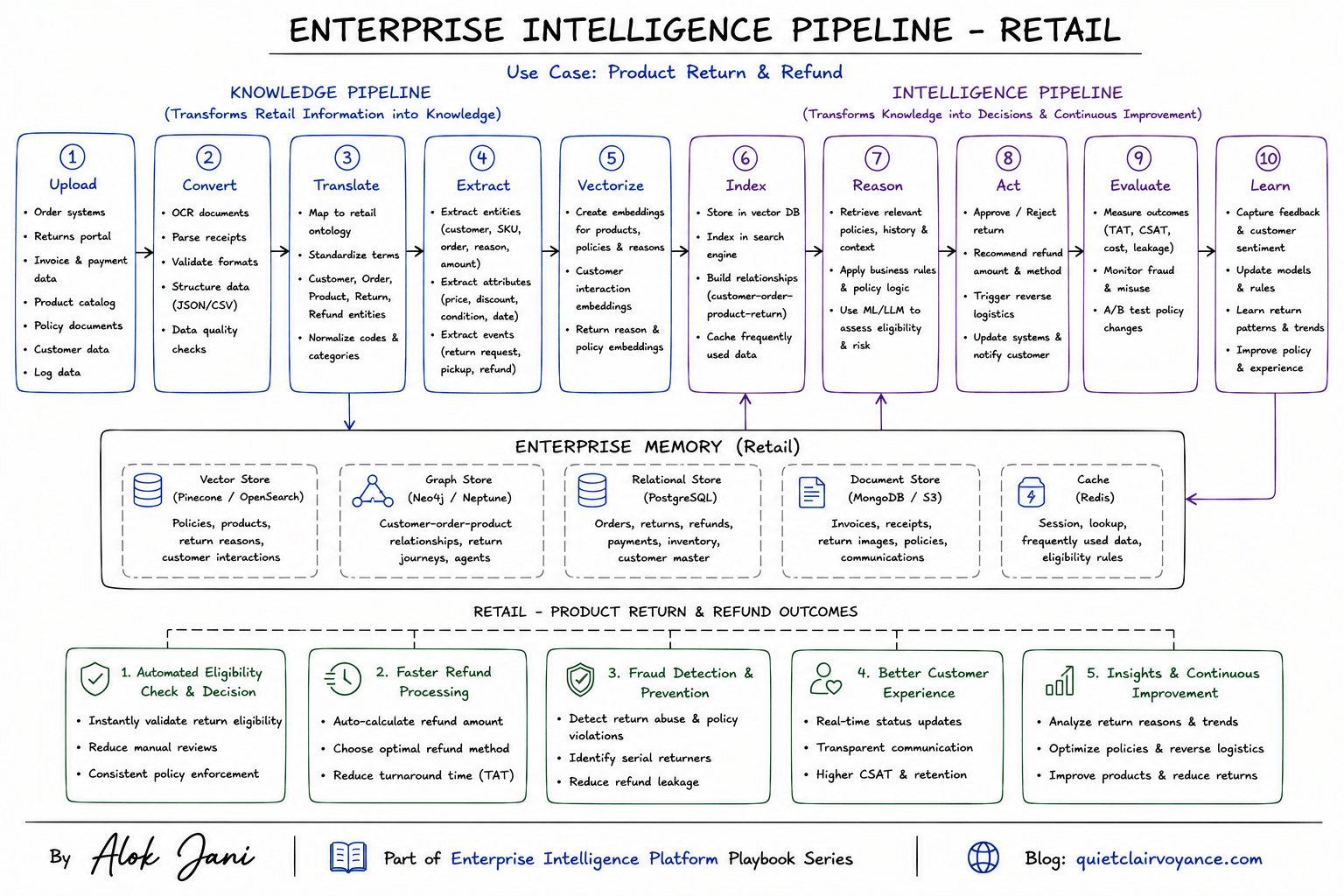
Every return flows through all ten stages. The customer emails about a defective product. Upload captures the email. Convert extracts the text. Translate maps it to retail ontology. Extract pulls out the order, SKU, customer tier, and defect category. Vectorize creates embeddings for similar cases. Index stores it across vector, graph, relational, and document stores. Reason applies return policy and eligibility rules. Act approves the refund, restocks inventory, and emails the customer. Evaluate measures turnaround time, CSAT, and fraud signals. Learn updates return patterns and improves policy.
One pipeline. Five outcomes: automated eligibility, faster refunds, fraud prevention, better customer experience, and continuous improvement.
Healthcare: Patient Diagnosis
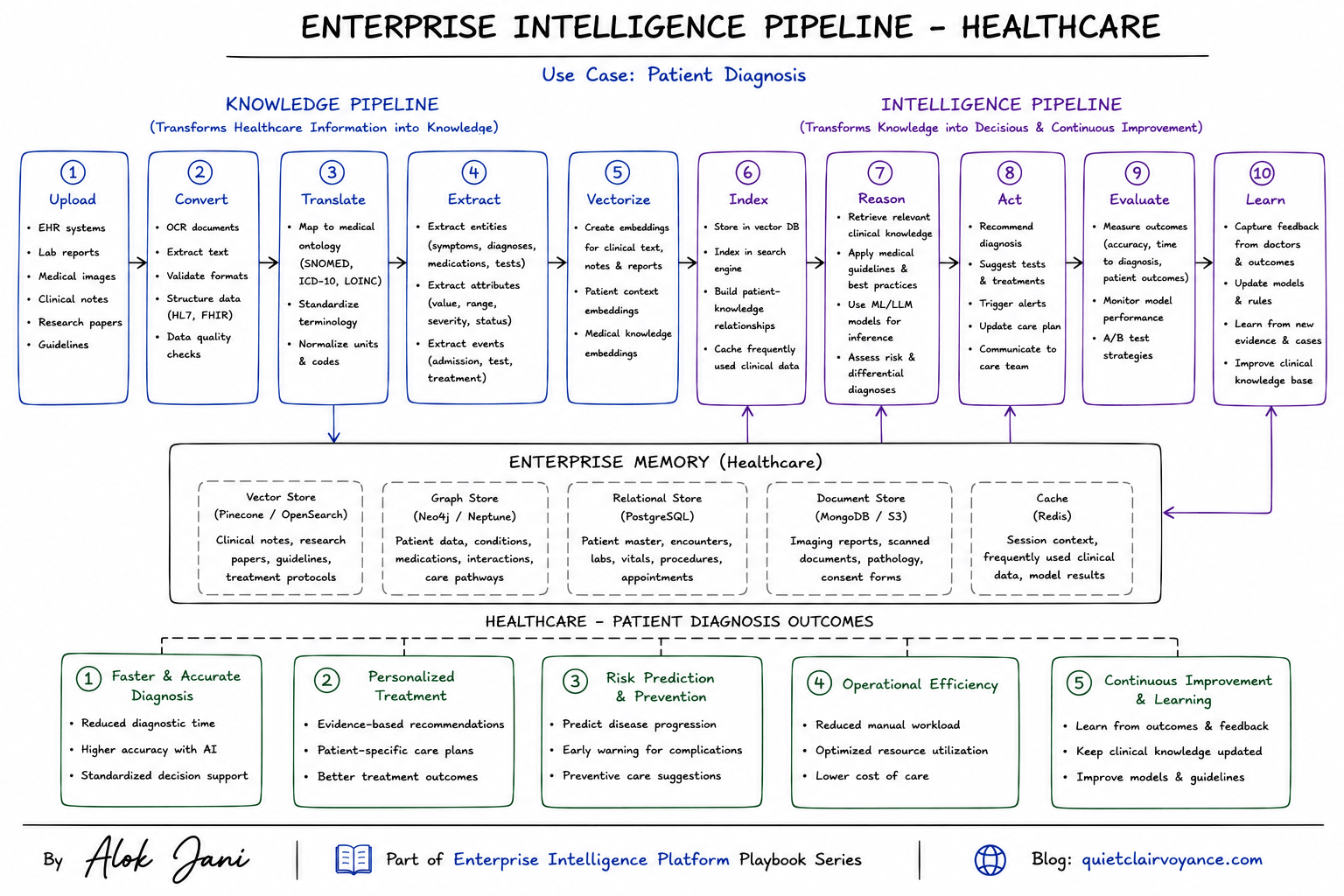
Every diagnosis flows through all ten stages. The lab submits results. Upload captures the report. Convert extracts text and validates HL7/FHIR formats. Translate maps to medical ontology (SNOMED, ICD-10, LOINC). Extract pulls out symptoms, diagnoses, medications, and test values. Vectorize creates embeddings for clinical notes and research papers. Index stores across vector, graph, relational, and document stores. Reason retrieves clinical guidelines and uses ML models to assess risk and differential diagnoses. Act recommends diagnosis, suggests tests, and updates the care plan. Evaluate measures diagnostic accuracy, time to diagnosis, and patient outcomes. Learn captures feedback from doctors and updates clinical knowledge.
One pipeline. Five outcomes: faster accurate diagnosis, personalized treatment, risk prediction, operational efficiency, and continuous learning.
What I’ve Learned
Platform Engineering transformed software delivery by creating reusable platforms instead of bespoke infrastructure. Enterprise Intelligence will transform decision-making in exactly the same way.
The organizations that succeed will not build the most agents. They will build the best pipeline. The pipeline is the moat, not the models.
The pipeline has two halves. The Knowledge Pipeline (ingest through index) and the Intelligence Pipeline (reason through learn). Both are required. You cannot have intelligence without knowledge, and knowledge without intelligence is just a database.
Enterprise Memory is the bridge. It transforms raw information into trusted knowledge that decision agents consume. Poor memory creates poor decisions. Rich memory creates intelligent organizations.
Learning is not optional. Every decision must feed back into the system. Without learning, you have automation. With learning, you have intelligence. That is the difference between a workflow engine and an intelligence platform.
Enterprise Intelligence Operations operates the flow, not the models. The pipeline is the production workload. Models are components. If you are monitoring model accuracy but not decision quality, you are measuring the wrong thing.
One pipeline powers every decision agent. From mortgage approval to network diagnosis to inventory optimization, the architecture is the same. The objects change. The verbs do not.
Standardization is the entire point. The reason Platform Engineering won was not because containers were great. It was because standardization created leverage. The same is true for Enterprise Intelligence.
Part 5 of the Enterprise Intelligence Platform Playbook covers the transformation roadmap. How do you move from experimentation to operational intelligence? What are the phases? What are the risks? What are the success criteria?